

Garden State Secrets in The Happy Hollisters and the Secret Fort by Jerry West
Jerry West’s Inspiration for The Happy Hollisters and the Secret Fort
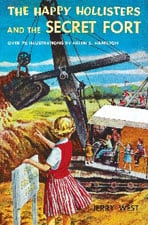
The Happy Hollisters and the Secret Fort is a fun example of how New Jersey author Andrew Svenson wrapped historical and educational tidbits into adventurous mysteries that his fans couldn’t put down!
A young Happy Hollisters fan named Thomas wrote to Jerry West in 1971:
“I have read some of your Hollister books. The one I am requiring [sic] about is The Happy Hollisters and the Secret Fort. Sometimes I can’t stop reading your book. I enjoy the excitement. I would like to ask a few questions about this book. What gave you an idea about this book?”
Andrew Svenson (aka Jerry West) responded, “The idea for Secret Fort came to me when they began building the Garden State Parkway near my house. At that time, a number of old foundations were unearthed.”
Excitement is introduced in the opening chapters of Secret Fort when the Happy Hollisters learn that construction of a new highway may be linked to the long-buried earthen remains of a Revolutionary War fort in their town of Shoreham.
Find Fort Freedom: $500 Reward! “The town of Shoreham will pay ten thousand dollars to the owner of the property on which Fort Freedom is located, and the Shoreham Eagle is offering five hundred dollars’ reward to the person making the discovery.”
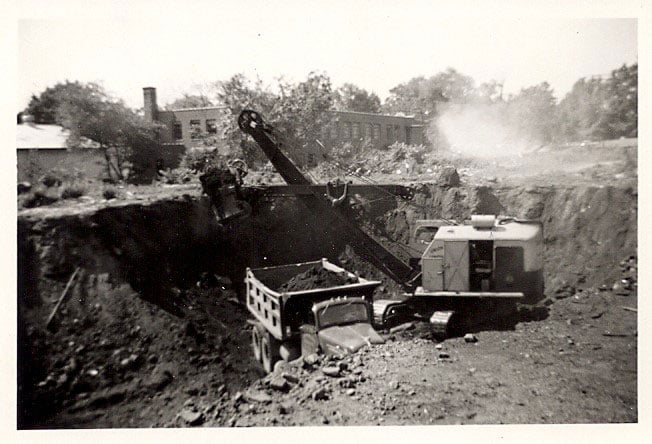
Secret Fort was originally published in 1955, while Svenson and his family lived in Bloomfield, New Jersey. Construction of the Garden State Parkway officially began near their home in 1946, but the first four years of work yielded only four miles of finished road. Between 1952 and 1956, the remainder of the route which stretches from Cape May in South Jersey to the New York state line in the north, was completed. Demolition and construction were in full swing during Svenson’s research and writing periods.
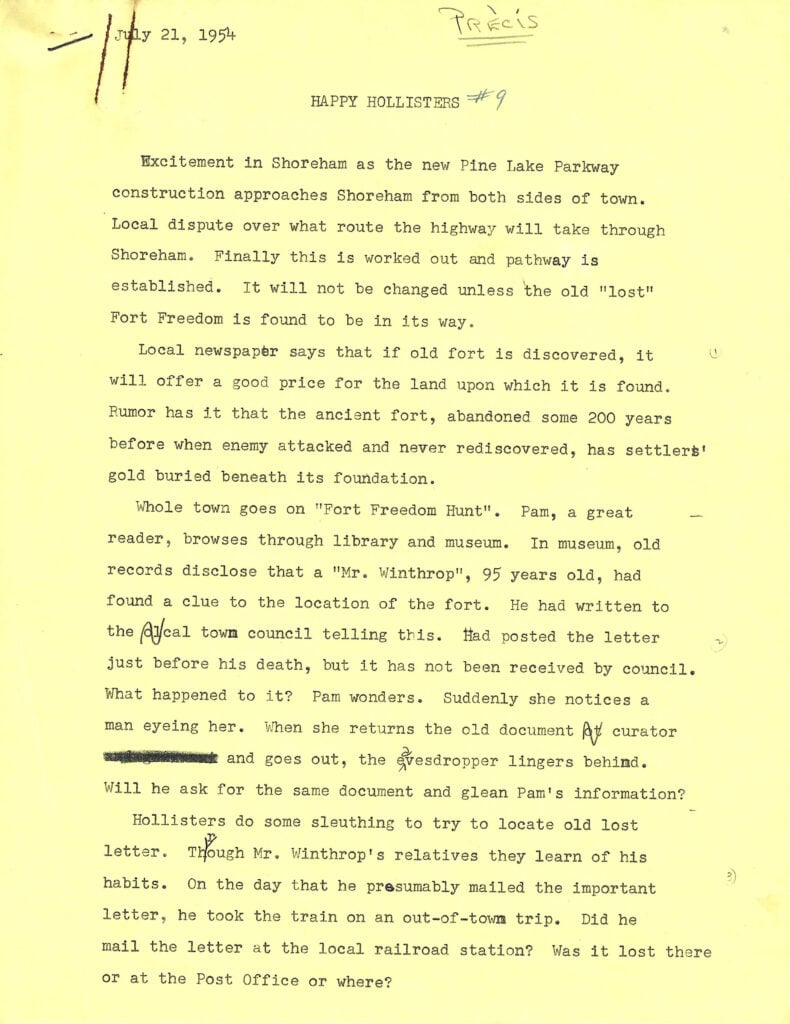
In the book, members of the road construction crew working on the “Pine Lake Parkway” ask the Hollister children for directions “to the Belleville Avenue entrance of the new road-construction job.” While the Pine Lake Parkway is a thin disguise for the Garden State Parkway, Belleville Avenue (Exit 149) is a real street in Bloomfield, just one block north of the Svenson family’s old home on Church Street.
Svenson’s idea for Secret Fort may have begun with the Garden State Parkway, but once he started digging deeper into New Jersey’s history, the bigger story stretched back to the days of the Revolutionary War and the days when George Washington and his troops mustered near Essex County. With battlegrounds, encampments, museums, reconstructed forts, and other historic sites scattered throughout the state, New Jersey is known as the “Military Capital of the American Revolution” and several episodes from its rich history were mashed together to create the exciting plot for Secret Fort.
As Pete, Pam, Ricky, Holly, and Sue explore their neighborhood in search of clues to the whereabouts of the original Fort Freedom, Ricky falls down an abandoned well. Unhurt, he is surprised to find himself in a tunnel built underneath a friend’s home.
Local Bloomfield lore tells of a tunnel that connected the Joseph Davis House (built in 1676 and now home to the Bloomfield Steak and Seafood House) to the Church on the Green. The former Svenson home on Church Street, like Fort Freedom, is long gone, but it was a stone’s throw from the Church on the Green. There is no doubt that Svenson and his children had heard rumors of a tunnel network, and probably spent many summer afternoons exploring their neighborhood in search of tunnel entrances and historic artifacts.
Andrew Svenson’s hometown of Belleville, just a few miles southeast of Bloomfield, was originally known as “Second River.” When British troops advanced across the Hudson River into northern New Jersey in November 1776, George Washington and his troops fled their barracks at Fort Lee and began a nearly two-week retreat through New Jersey. Their march took them through Second River as they made their way to Trenton, and today a series of “Retreat Route” signs indicate their path so that history buffs and tourists can follow in their footsteps.
The remains of Fort Freedom, described in Secret Fort as being “somewhere within the boundaries of Shoreham,” may have been inspired by Fort Lee or one of the other revolutionary forts originally constructed in New Jersey and now lost to time. Fort Lee Historic Park, high in the Palisades of Northern New Jersey, offers a glimpse into Revolutionary history through tours of a reconstructed encampment. The view from the park is stunning, stretching across the Hudson and down to the Manhattan skyline. A museum built on the grounds of Fort Mercer can be explored at Red Bank Battlefield Park in National Park, New Jersey. Fort Nonsense was built near Morristown under orders from General Washington in 1778, and although no structures remain, plaques and markers at the Morristown National Historical Park provide an educational look into the history of the site. Perched on a hilltop in north-central New Jersey, visitors can enjoy the same views that Washington and his troops saw as they marched across the state.
Svenson’s interest in road construction, tunnels, and military history did not end with Secret Fort. Volume 17 in the Happy Hollisters series, The Mystery in Skyscraper City, leads the intrepid Hollister children into the tunnels beneath New York City’s Chinatown in search of a stolen jade statue. A similar storyline is used in The Hardy Boys Secret of the Lost Tunnel (written by Andrew Svenson based on an outline by Stratemeyer Syndicate head Harriet Adams, also a native of Essex County). The story’s timeline is a bit different, though, as Frank and Joe Hardy search for hidden gold in a Civil War-era tunnel. The Hardy Boys Mystery of the Spiral Bridge, which he outlined and wrote in 1966 under the pen name Franklin W. Dixon, also dealt with the theme of road construction.
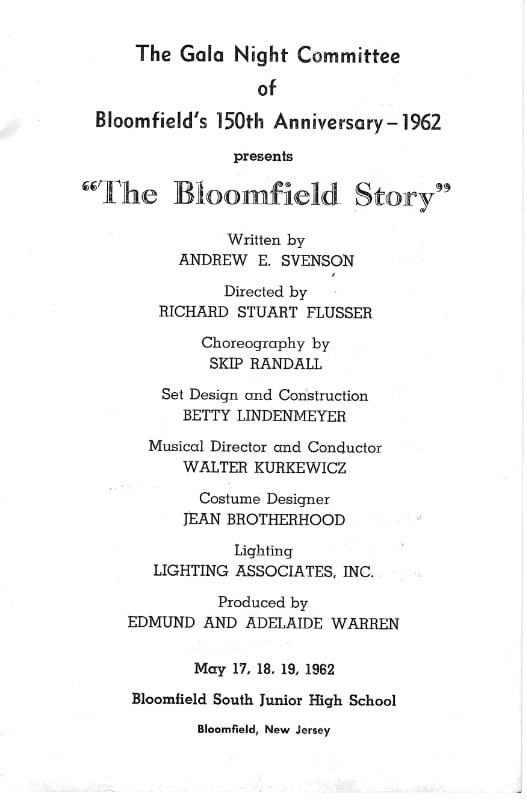
His deep-dive into the history of Essex County and his knack for storytelling also made Andrew Svenson a natural choice when the Bloomfield 150th Anniversary Committee was looking for a writer. He was tapped to write the script for “The Bloomfield Story” to commemorate the town’s sesquicentennial in 1962. As the play opens in Scene I, residents of the town welcome George Washington, Alexander Hamilton, and the Marquis de Lafayette, who have arrived on horseback for a brief overnight stay in Bloomfield in 1778. The musical presentation in eight scenes covers Bloomfield’s history from the Revolutionary War era through “present day.”
Although “present day” has now stretched another 60 years into the future since Andrew Svenson’s time, and the U.S. is now celebrating its semiquincentennial, The Happy Hollisters and the Secret Fort is a swell teaser for young readers with an interest in road construction or military history. The exciting clues that the Happy Hollisters unearth in the story might inspire today’s children to look into their own town’s history. What famous people were born in your town? Look at an old, detailed map of where you live; does it show buildings that have been torn down? Are there Revolutionary War or Civil War battlefields in your area? Treasures might be found in your own back yard—get a shovel and start digging!
Sources & References for Further Information:
Crossroads of the American Revolution
Revolutionary War New Jersey
https://www.revolutionarywarnewjersey.com/
National Governors Association
https://www.nga.org/governor/joseph-bloomfield/
New Jersey’s History Garden State Parkway
“We Celebrate!” By Herbert Fisher in the Official Souvenir Program of Bloomfield’s 150th Anniversary