
Footprints on Black Sand Beaches
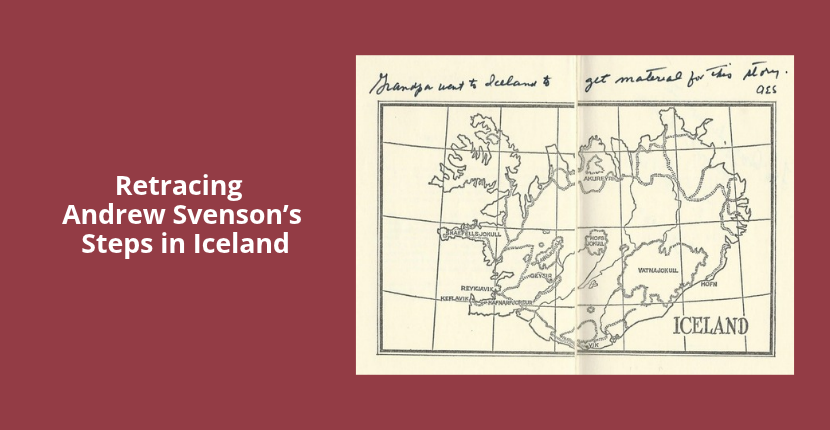
Retracing Author Andrew Svenson’s Steps in Iceland
Iceland is known as the Land of Fire and Ice, admired for its exciting volcanic and glacial formations, distinctive black sand beaches, relaxing geothermal spas, phenomenal views of the Northern Lights, and breathtaking waterfalls. More than 90% of Icelanders speak English fluently, and the country has consistently been ranked at the top of safest travel destinations. It has become a popular bucket list destination for tourists in recent years, but Stratemeyer Syndicate partner and author Andrew E. Svenson arrived well ahead of the crowds, visiting in 1968.
Iceland is a small country (about the size of the U.S. state of Kentucky) but its larger-than-life landscape and unique Nordic traditions offered plenty of inspiration for children’s stories—enough for two separate books, in fact!
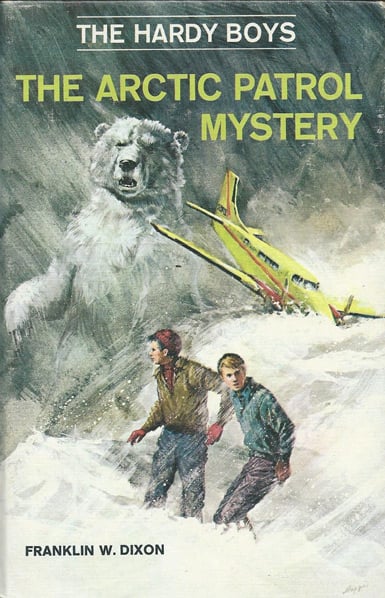
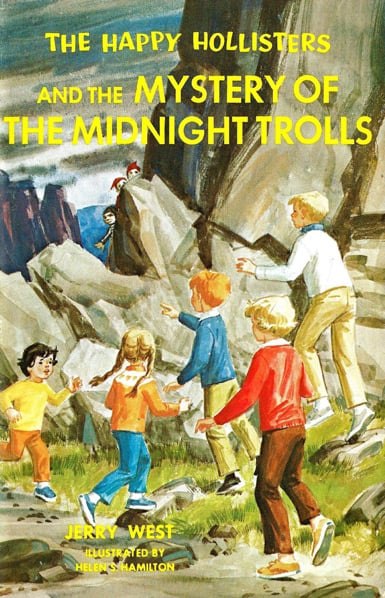
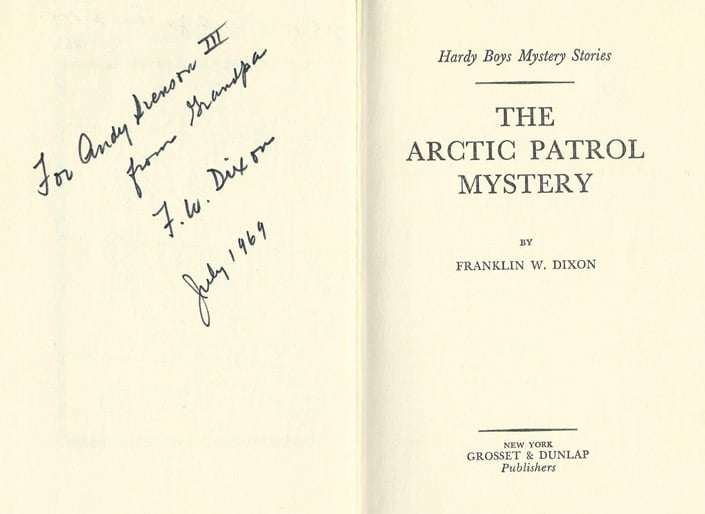
The Hardy Boys Arctic Patrol Mystery, which Andrew wrote as Franklin W. Dixon, and The Happy Hollisters and the Mystery of the Midnight Trolls, which he wrote as Jerry West, reflect his deep appreciation for the country’s rich historical background and Nordic mythology. In July 1969, he dedicated a copy of The Arctic Patrol Mystery to his grandson, Andy Svenson III, with a special notation, “Grandpa went to Iceland to get material for this story.”
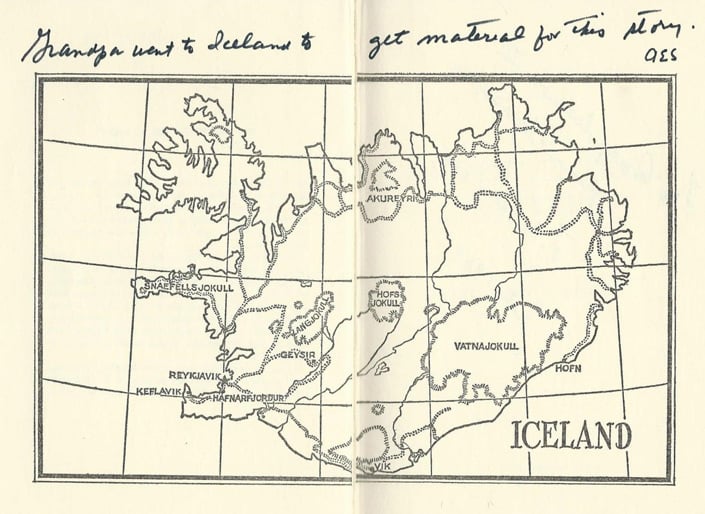
Andrew’s research trip was suggested after he read newspaper articles about NASA’s 1965 and 1967 training expeditions to Iceland. Dozens of astronauts, including Eugene Cernan, Roger Chaffee, and Neil Armstrong, spent training sessions on the volcanic island in preparation for their Apollo missions. Iceland’s austere landscape closely resembled the lunar surface and offered opportunities for replicating experiments that would support their activities on the moon. The astronauts’ research exercises included collecting and identifying rock samples, studying volcanic layers, and mapping geological formations. A nod is given to the NASA program in Arctic Patrol, when Frank and Joe Hardy become involved in a mystery surrounding “three U.S. astronauts who came here to study our lava surface, which is very similar to the terrain on the moon.” [Chapter 3]
If you read both of these books, it’s fairly easy to follow in Andrew’s footsteps, rebuilding his itinerary and imagining how certain details of Icelandic life caught his eye. Certain elements made such an impression on Andrew that they wound up in both books. Similar passages in Arctic Patrol and Midnight Trolls describe the stark volcanic countryside, dotted with brightly colored roofs and huge water tanks. Both the Hardys [Chapter 4] and the Hollisters [Chapter 12] mistake the tanks for oil tanks. Their Icelandic friends explain that hot water from underground springs is stored in the huge tanks, providing heat for all the residents.
Andrew arrived in Iceland with the notion that polar bears wandered freely across the island. We suspect that he was quickly corrected on this bit of misinformation by his local guides, and he made sure to educate his young readers accordingly in both books. Polar bears are not native to Iceland, but they do occasionally float over from Greenland on drifting chunks of sea ice. A polar bear was seen in northern Iceland around the time of Andrew’s visit, but fewer than a dozen have been documented since then. Still, in Arctic Patrol several villains are chased by a large bear, allowing Frank and Joe to make a daring escape. [Chapter 17]
In The Happy Hollisters and the Mystery of the Midnight Trolls, the Hollister family travels to Iceland to attend a sailplane competition in which Mr. Hollister hopes to enter his home-built sailing invention. They are invited to stay in the guest house of an Icelandic family living in the countryside outside Reykjavik. [Chapter 11] Frank and Joe Hardy stay at the Hotel Saga in Reykjavik, described as a “modern white hotel located at the hub of three radiating roads.” [Chapter 3] The Hotel Saga (later known as the Radisson Blu Saga Hotel) was built in 1962, and we think it was Andrew’s base of operations during his time in Reykjavik.
Since Andrew Svenson was of Swedish descent, he was familiar with the patronymic naming system used in many Nordic countries, including Iceland. His own surname was originally spelled Svensson, meaning “son of Sven.” The Happy Hollisters befriend an Icelandic girl named Helga Karlsdottir who tells them, “We have a peculiar way of naming people in Iceland.” She explains that she has a different last name than her father, Karl Sveinsson, because the children of a man named Karl are given the surname Karlsson (boy) or Karlsdottir (girl). Pam catches on right away, realizing that her name would be Pam Johnsdottir, but Ricky would be Ricky Johnsson! [Chapter 6]
Frank and Joe Hardy get a similar lesson in patronymics from their new friend, Gusmundur “Gummi” Bergsson, whose father’s name is Bergs Anderson. [Chapter 3] Icelanders are commonly addressed by their first name rather than their surname; alphabetized directories (phone books, for example) list individuals by their first name, often adding the person’s profession as an additional means of identification.
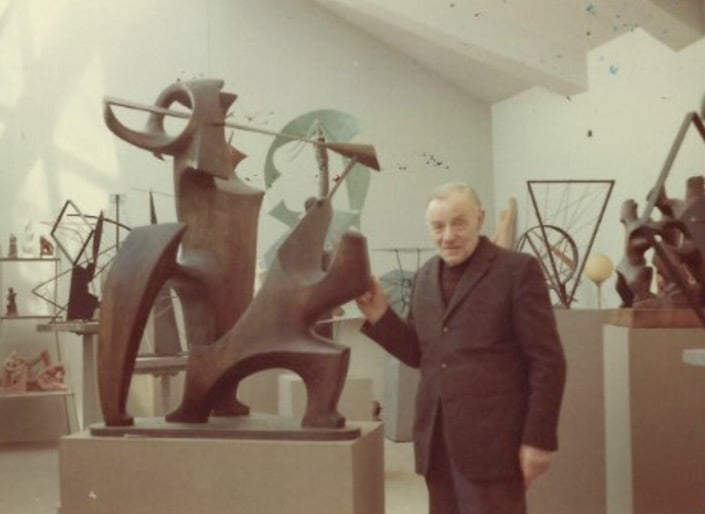
We had assumed that Karl Sveinsson in Midnight Trolls was so named as an Easter-egg hint to the author’s real name, or as an homage to his grandfather Karl Edvart Svenson. However, we recently discovered a photograph of Andrew with an Icelandic sculptor named Ásmundur Sveinsson. Andrew met with Ásmundur in his art studio, which is now the Ásmundur Sveinsson Sculpture Museum (Ásmundarsafn), affiliated with the Reykjavík Art Museum. Ásmundur is shown here in his studio next to his sculpture called Davíð og Golíat (David and Goliath). We now believe that Karl Sveinsson was actually included in the book to honor Ásmundur.
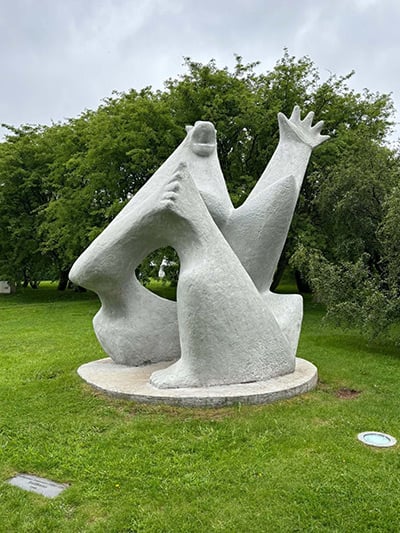
One of Ásmundur’s most popular sculptures is his 1948 Tröllkonan (Troll Woman). Trolls figure heavily in Icelandic mythology, inspired by the petrified stacks of basalt and volcanic ash that rose out of sea in eerie, lifelike formations. Early Icelanders linked these natural statues with legends about nocturnal giants who were turned to stone with the sunrise. These stories have been shared over thousands of years through Icelandic storytelling traditions, and the Hollisters’ friend Olaf tells “of an old woman troll who was hurrying home carrying a big fish on her back . . . Daylight came before she got there, and she was changed to stone. To this day, the old lady stone troll with the fish on her back can be seen by visitors on the northwest coast.” [Chapter 15]
Andrew Svenson had a hunch that these eerie stories from Icelandic folklore would appeal to his young readers in Midnight Trolls. The Hollisters learn more about the legendary trolls and elusive huldefolk (hidden people) from Helga and Olaf. The Hollisters are dubious of their existence, but when Mr. Hollister’s sailplane is pirated before the competition, several weird events convince them that magical folk might be mixed up in the mischief after all.
The Hardy Boys Arctic Patrol Mystery and The Happy Hollisters and the Mystery of the Midnight Trolls are two very different stories, but a careful reader of both books will definitely notice similarities. Writing as both Franklin W. Dixon and Jerry West, Andrew Svenson shared his real-life adventures in Iceland with two different age groups.
The Hardy Boys Arctic Patrol Mystery is definitely edgier, intended for older readers (9-15), with a harrowing plane crash on a glacier, kidnapped astronauts, and polar bear chases. One incident in Arctic Patrol reflects a situation which was described as Andrew Svenson’s most memorable research adventures. His business partner, Harriet Adams (née Stratemeyer), recounted it in a 1970 speech: “While in Iceland researching for Arctic Patrol Mystery, Mr. Svenson was traveling in an Icelandic cutter. During the middle of the night it was necessary to transfer to another cutter by raft. This is a once-in-a-lifetime experience, because once is enough; the North Atlantic at the Arctic Circle is rough and cold and deep. The Hardy Boys had this adventure in the book.” [Chapter 11]
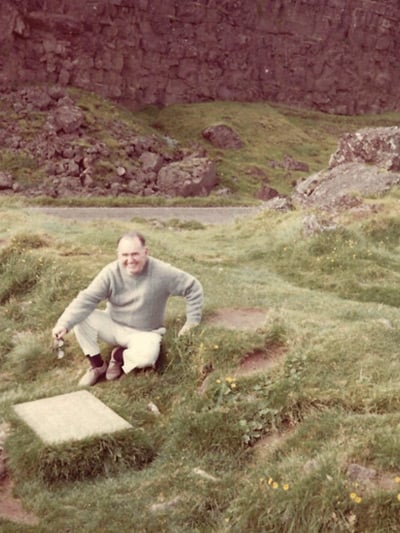
The Happy Hollisters and the Mystery of the Midnight Trolls has a quainter, more lighthearted feel as the Hollisters travel around Iceland in search of their father’s missing sailplane. With their new friends, the children learn much about Icelandic history and culture as they explore the National Museum of Iceland and look for treasures at Thingvellir National Park. It is written at a level to appeal to children aged 6-12.
If you read both of these books, be on the lookout for similarities between them. There are many more that we have not included here. And if you ever visit Iceland, be sure to tell them Andrew Svenson sent you!
Photographs:
Ásmundur Sveinsson with David and Goliath, Wood Sculpture; Photographer A. Svenson, 1968
Troll Woman by Ásmundur Sveinsson; Photographer B. Carnahan, 2026
Andrew Svenson at Thingvellir National Park; Photographer Unknown, 1968
Additional Sources/Resources:
Andrew Svenson Archives, The Hollister Family Properties Trust
The Hardy Boys Arctic Patrol Mystery by Franklin W. Dixon
https://thehappyhollisters.com/product/hb48-the-arctic-patrol-mystery/
The Happy Hollisters and the Mystery of the Midnight Trolls by Jerry West
Polar Bears in Iceland
https://perlan.is/articles/polar-bears-in-iceland
Ásmundarsafn Art Museum
https://listasafnreykjavikur.is/en/asmundarsafn-en
The Icelandic Yule Lads and Their Mother Gryla
https://guidetoiceland.is/history-culture/the-icelandic-yule-lads-and-gryla
Thingvellir National Park
Icelandic Yule Traditions: Small Country, Big Christmas Spirit
https://thehappyhollisters.com/icelandic-yule-traditions/
National Museum of Iceland